 Kinfo is a familial social network designed to allow users to discover and document their ancestral roots, explore their living family network, and share media together.

Kinfo is a familial social network designed to allow users to discover and document their ancestral roots, explore their living family network, and share media together.
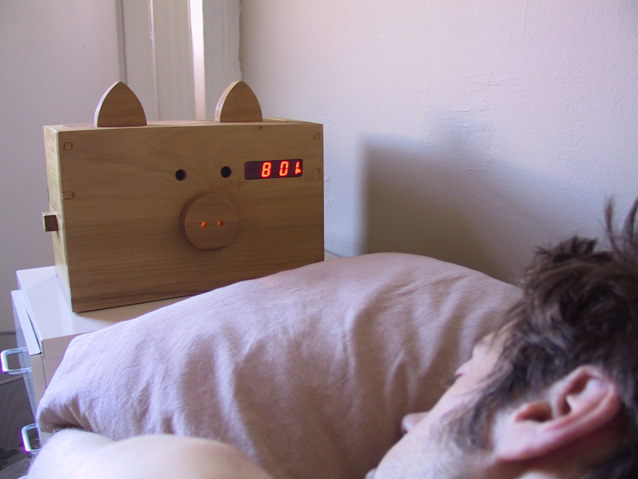 Version 1 by Matty Sallin, Daniel Bartolini, Hsiao-huh Hsu
Version 2 by Matty Sallin with engineering by Josh Myer
WHAT: An alarm clock that wakes you up with the smell of cooking bacon instead of a buzzer. The aroma wakes you up, then you can open the oven component and eat the bacon itself.
Continue reading
* Note: This article was written in June 2006 and reflects the Spotlight interface at the time.

Apple’s Spotlight technology is great for two primary reasons: first, it is so tightly integrated with the OS that it’s index is always up to date, and when it performs searches, it considers not just content, but also metadata. While the degree of search is unparalleled for desktop search, there are improvements to be made with regards to the user experience. Continue reading
by Matty Sallin and Greg Trefry
WHAT: A biofeedback lamp that detects and “echos” your own heartbeat in realtime. Just place your hands on either side of the lamp base and wait for it to detect your pulse, then watch as it throbs to match your heartbeat. The light is hypnotic, and you can actually watch your pulse slow down by focusing on the light and relaxing.

by Matty Sallin with David Herman
WHAT: ChitChat is an installation that projects a speech bubble above your head as you talk. The bubble swells with the text “blah bu blah blah” as you continue to talk. The output text reflects your volume by changing size. Textual attributes such as bold text and italic text also shift to reflect voice pitch. If you or friend remains silent, they will eventually get a corresponding thought bubble.

WHAT: A pair of networked photo frames that indicate the remote presence of the person in the photo. For example, if my sister in California moves around in front of her photo of me, my photo frame of her will gently flicker and light up here in New York, and vice-versa.

Sogetsu.or.jp is the first site I designed as a creative director. The Sogetsu Foundation is the most avant-garde school of Ikebana in Japan, Ikebana being the Japanese art of flower arrangement. The client was intentionally vague on the brief, only saying they wanted an imaginative design that was only dimly related to ikebana, and not to be too literal.

The "flower" is saturated until the user mouses towards the navigation
To echo the creative spirit of Sogetsu, I used Flash to dynamically create an abstracted “flower” out of geometric petals. Whenever a user comes to their homepage, they are greeted with a flower of unique shape and color. Continue reading
 The Tokyo Museum of Advertising is a monument to the history of advertising, and this site is the kiosk complement to the physical site. The board members envisioned a webpage that could be used by advertising professionals to research all sorts of advertising in both English and Japanese language, and they had an enormous database of video, sound and picture files to fill it with. The biggest challenge was: how do you present such a large breadth of advertising, how do you organize it, and how do you provide contextual relevance? Continue reading
Some earlier web design projects that I haven’t yet migrated to this blog. Click on each image to learn more about each site.
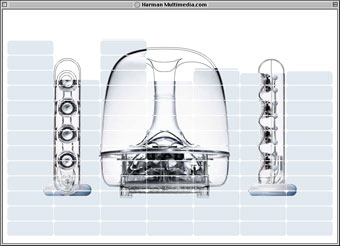
Harman-Kardon (1999): The first website I ever creative-directed, nominated for "Best Business Site" at the 2000 Flash Film Festival, London
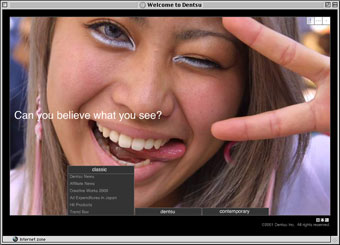
Dentsu (2001): The new homepage for the world's largest advertising firm, soon to be my next home from 2001-2003
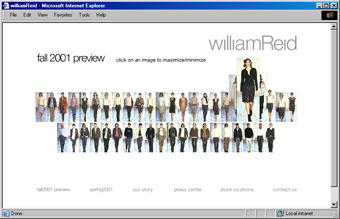
WilliamReid (2000): A flash-heavy fashion site
 Mathlete